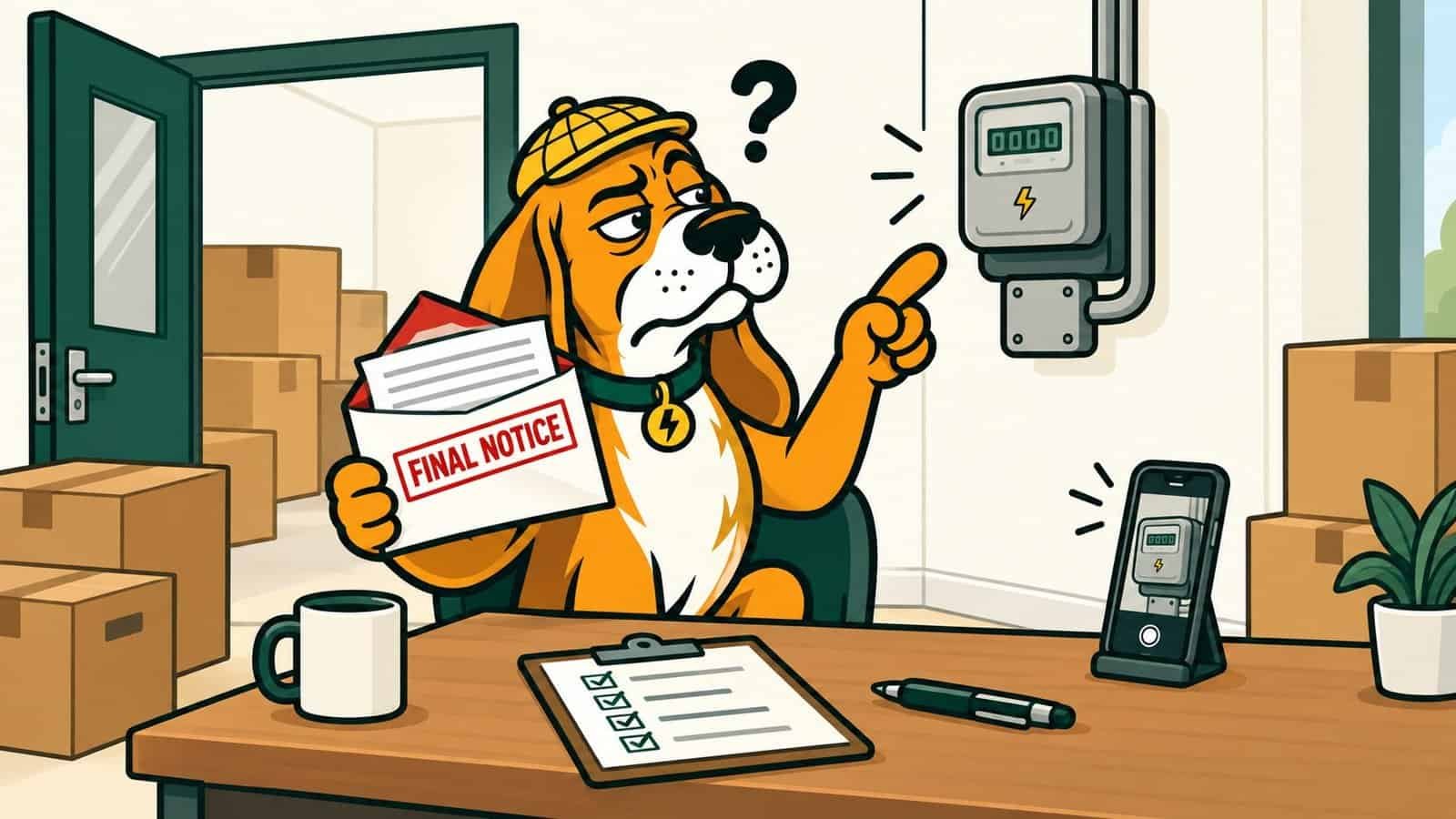
No. If an energy bill turns up for the business that traded in your premises before you, their debt is not yours. But binning it is the one thing you should not do. Until the supplier knows the tenancy has changed, the old account stays open, and you are quietly clocking up charges of your own on a rate you never chose. The fix is one phone call, a meter photo and a piece of paperwork.
This catches a lot of businesses in the first month at new premises. The removal vans are barely gone, and in among the mail for companies you have never heard of is a red-letter bill from an energy supplier. Sometimes it is addressed to the old limited company. Sometimes just to “The Occupier”. Either way, what you do next decides whether the account gets split cleanly or follows you around for months. This guide is the doing-it-properly route: what you owe, what you do not, and the evidence that draws the line between the two. If you have not moved in yet, read our day-one moving checklist first and most of this never happens to you.
The short version
- You are not liable for the previous tenant’s energy debt. You are liable for the energy you use from the day you take over.
- Until you arrange your own contract, your usage is billed by the previous tenant’s supplier on a “deemed contract”, and Citizens Advice warns those can cost a lot more than a tariff you have chosen.
- Opening-day meter photos and change of tenancy evidence are what split your account from the old one.
- The supplier has 10 working days to review your evidence. If they reject it, they must tell you why.
- A bill that is not yours still needs an answer. Ignoring it is how the account stays wrong.
Why their bill came to you
When a business moves out, its energy account does not close itself. Unless the outgoing tenant tells the supplier they have left, the meter keeps clocking and the bills keep coming, addressed to them, to their company name, or simply to The Occupier. When you move in and nobody tells the supplier anything, you inherit the letterbox.
Ofgem calls the fix the change of tenancy process (you will also hear change of occupier), and its guidance, published 27 June 2025, puts a job on both sides. The business moving out should say it has left. The business moving in should say it has arrived, even if it is already talking to other suppliers about contracts. Until somebody does, the supplier has one account, one energy supply, one meter, and no idea the name above the door has changed.
That is why the letter matters even when it is not addressed to you. An unopened, unpaid bill does not stop the account running. Left long enough, the supplier will chase the debt through letters to the premises, and in the worst case start asking questions about the supply itself. Opening the post and answering it is what protects you.
What you actually owe, and what you do not
The dividing line is the day you took over. Energy used at the premises before that day is the previous tenant’s responsibility, whoever’s name is printed on the bill. Energy used from that day onwards is yours.
Yours does not mean at a rate you agreed. If you moved in without a contract arranged, the previous tenant’s supplier keeps the energy supply running under what is called a deemed contract. Citizens Advice is blunt about deemed contracts: they can cost a lot more than a tariff you would choose. So there are always two jobs, not one. Tell the current supplier you are there, so the old account closes and yours opens from the right reading. Then arrange a proper contract, so your own usage stops being billed at deemed rates. The second job is exactly what our guide to what a business energy quote needs prepares you for.
One more protection is worth knowing, for the back bill that covers your own period but looks wrong. Ofgem’s back-billing rules say households and microbusinesses do not have to pay for energy used more than 12 months earlier if they were never accurately billed for it, or told what they owed through a statement of account, unless they acted unreasonably, for example by blocking access to the meter or ignoring requests for payment. Businesses larger than a microbusiness are generally not covered, so never sit on a bill you know is wrong in the hope a rule will rescue you.
The evidence that draws the line
The supplier splits the account on evidence, not on your say-so, and your meter readings are the half of that evidence only you can supply. Ofgem’s change of tenancy guidance lists what they can ask for: tenancy or lease agreements, property sale documents, or title deeds. Citizens Advice says to be ready to show at least one of the following: confirmation from the landlord if you are renting, confirmation from the solicitor or estate agent who handled the move, a copy of your business rates statement, or the mortgage completion letter if you bought the property.
The other half of the evidence is the meter. Photograph every gas and electricity meter reading on your first day and note the date. Do it even if the electricity meter or gas meter is smart, because a smart meter is only sending readings if it is working in smart mode, and you will not know that on day one. Those photos are the number that separates their usage from yours.
| Evidence | What it proves to the supplier |
|---|---|
| Tenancy or lease agreement | The date your occupation started |
| Landlord confirmation letter | The tenancy changed hands |
| Solicitor or estate agent confirmation | The sale or letting completed |
| Business rates statement | Your business is the rated occupier |
| Mortgage completion letter or title deeds | You own the premises from a set date |
| Opening-day meter photo | The exact reading your liability starts from |
Getting the account split, step by step
- Find out which utility provider supplies the property. Ask the landlord or the agent first; it is the quickest route. If that fails, there are lookup services that name the energy provider for gas and electricity, and Citizens Advice links to them from its moving-premises guidance.
- Contact that supplier and register as the new occupier. Give your company name, the date you took over and your opening readings. Do this even if you plan to switch away: Ofgem is explicit that you should notify the current supplier while you are still discussing contracts with new ones, because it avoids billing delays and complications.
- Send the evidence when asked. The supplier reviews it within 10 working days and then does one of three things: closes the old account and opens yours, rejects the change of occupier with a reason, or asks for more information, making clear what is needed and why. Ofgem’s examples of extra evidence include mortgage documents, business rates bills, or bank, solicitor or landlord letters.
- If you are switching, tell both suppliers. Your new supplier starts the switch. The current one accepts it once it agrees the occupier has changed, or rejects it and gives a reason.
- Check the first bill on your new account. The opening reading should match your day-one photo, and if you pay by Direct Debit, check the first amount collected matches the tariff you agreed. If anything is off, query it immediately, in writing, while the evidence is fresh.
If the supplier drags its feet
Ofgem names the situations where you should complain: you receive an unexpected or unpaid bill you cannot make sense of, you disagree with the supplier’s decision on your change of tenancy, the review takes longer than 10 working days, or you think the extra information being demanded is unreasonable. Start with the supplier’s own complaints process and keep everything in writing, with dates.
If the complaints process does not resolve it, microbusinesses can take the case to the Energy Ombudsman, and Citizens Advice can help at any stage. A rejected change of occupier is not the end of the road: the supplier must give the reason, and weak reasons tend to collapse once the evidence above is put in front of an ombudsman.
Moving out? The same problem in reverse
Every previous tenant was once you. When your business leaves premises, close the electricity account properly or the next occupier’s usage lands on your final bill, and you become the debt somebody else is writing an article about. Citizens Advice’s moving-out list is four steps: tell your supplier the date you are leaving as soon as you can, give them a forwarding address, photograph the meter readings on your last day and note the date even with smart meters, and switch everything off, because anything left running can still be charged to you until the account closes and the closing bill is issued.
How BES fits in
Disputes are not our side of the fence. If a bill is not yours, the route above, supplier first, then the Energy Ombudsman, is the one that fixes it. Where we do fit is the second job: replacing the deemed rate with a contract you have actually chosen. Send a recent bill through the site and we introduce you to an energy partner who can quote for your usage, then you compare the offer and decide. If you are mid-move right now, our day-one moving checklist walks the whole move in order, and our guide to comparing business energy quotes once every charge is included shows what a like-for-like quote looks like when the offers arrive.
Frequently asked questions
Am I liable for the previous tenant’s business energy debt?
No. Liability follows usage, not the letterbox. Energy used before the day you took over is the previous tenant’s responsibility, and the supplier splits the account once you give them your start date, opening meter readings and change of tenancy evidence such as a lease, landlord confirmation or business rates statement.
What is a deemed contract when a business moves into new premises?
A deemed contract is the default arrangement that exists between you and the previous tenant’s supplier from the day you move in, before you have agreed anything. It keeps the lights on, but Citizens Advice warns deemed contracts can cost a lot more than a tariff you choose yourself, so treat arranging a proper contract as an urgent job, not an admin one.
What proof of change of tenancy does a business energy supplier need?
At least one document showing when your occupation started: a tenancy or lease agreement, confirmation from the landlord, confirmation from the solicitor or estate agent, a business rates statement, or a mortgage completion letter if you bought the premises. Ofgem also lists property sale documents and title deeds, and suppliers can ask for more, but they must say what and why.
How long does a change of tenancy take with a business energy supplier?
Ofgem’s guidance says the supplier reviews your change of tenancy evidence within 10 working days, then either closes the old account and opens yours, rejects the change with a reason, or requests specific further information. If the review runs past 10 working days, that delay is itself grounds for a complaint.
Can a business energy supplier back-bill a microbusiness for old usage?
Only within limits. Ofgem’s back-billing rules mean a microbusiness does not have to pay for energy used more than 12 months earlier if it was never accurately billed for it, unless it acted unreasonably, for example by blocking meter access or ignoring payment requests. Larger businesses are generally not covered by the same limit.
Should I ignore a business energy bill addressed to the previous company?
No. The account behind that bill is still open and still clocking usage, some of which is now yours. Open it, then contact the supplier with your takeover date, opening readings and evidence, so the old tenant’s balance stays with them and your account starts clean.
Who do I complain to about a business energy bill that is not mine?
Start with the supplier’s own complaints process, in writing. Ofgem says you should complain if you get an unexpected bill, if the change of tenancy decision goes against you, if the review takes more than 10 working days, or if the evidence demands seem unreasonable. After that, microbusinesses can go to the Energy Ombudsman, and Citizens Advice can help you prepare.
Sources and checks
- Ofgem: Change of tenancy for businesses (guidance published 27 June 2025; the change of occupier process, evidence, 10-working-day review and complaint triggers).
- Citizens Advice: Dealing with your energy supply when you move business premises (proof list, meter photos, deemed contract warning, moving-out steps).
- Ofgem: What to do if you get a back bill (the 12-month back-billing limit for households and microbusinesses).
Checked 21 October 2026. This guide is general information, not legal or debt advice; if a supplier or collector is actively pursuing you, talk to Citizens Advice or a qualified adviser about your specific case.