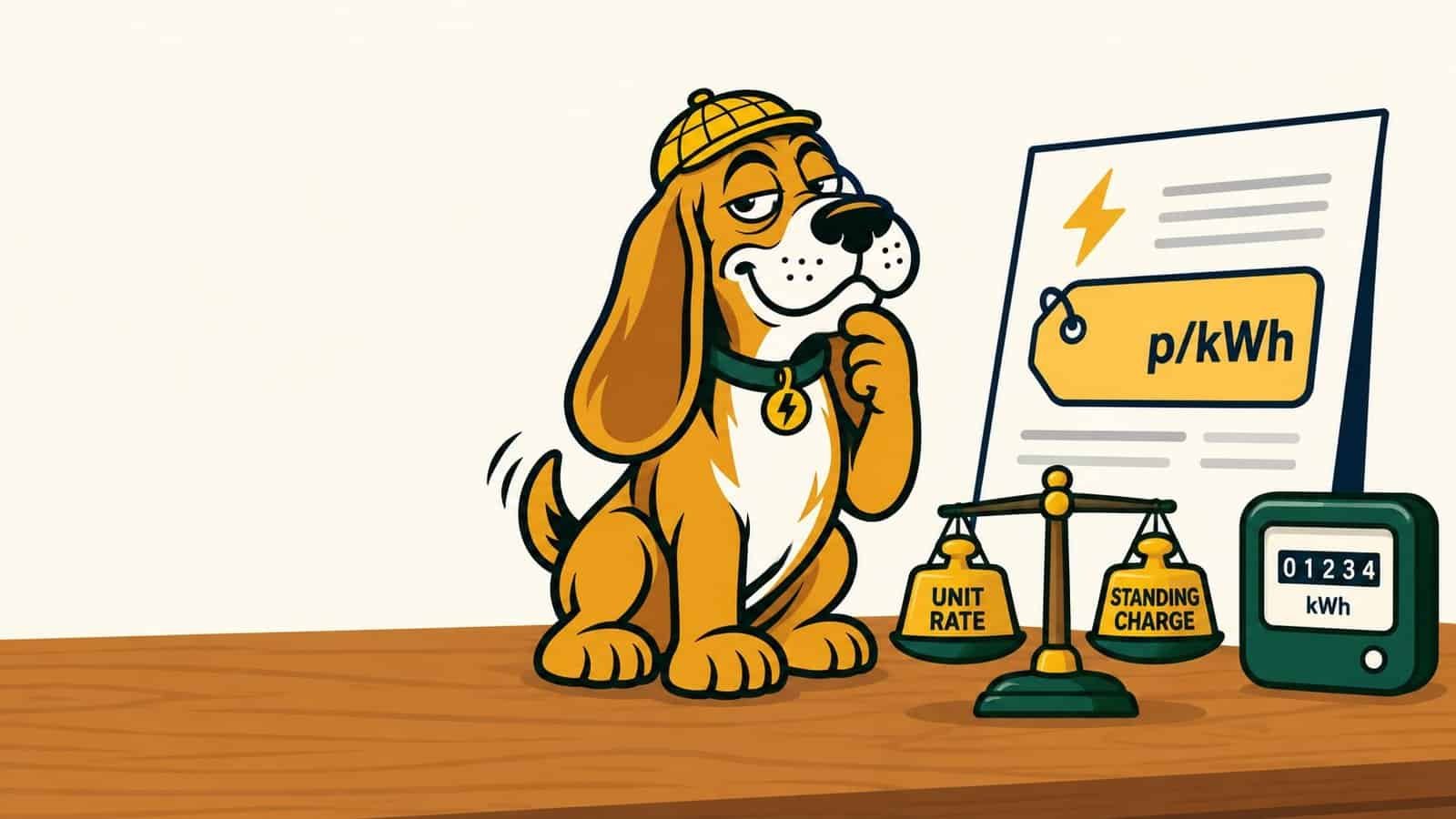
As of October 2026, a small UK business using 10,000 to 50,000 kWh a year is typically quoted a unit rate in the high 20s to low 30s pence per kWh on a one-year fixed contract. Bigger users pay less per kWh. A daily standing charge sits on top. Your exact rate depends on your usage, meter, region, contract length and when you buy.
It is the most common question we hear, and the most honestly awkward one to answer, because there is no single business electricity price per kWh. Unlike domestic energy, business energy has no price cap, so every supplier prices every business individually. What we can give you is the current market picture, dated and sourced, and a straight explanation of why your quote will look the way it does.
What businesses are actually paying right now
The closest thing to a public benchmark is the average of live supplier offers. AquaSwitch, a business utilities comparison service, publishes the average one-year fixed business electricity rates currently offered by its supplier panel, split by business size. This is what its October 2026 table shows:
| Business size | Annual electricity use | Average 1-year fixed unit rate (October 2026) |
|---|---|---|
| Small | 10,000 to 50,000 kWh | 31.2p per kWh |
| Medium | 50,000 to 100,000 kWh | 29.2p per kWh |
| Large | 100,000+ kWh | 29.0p per kWh |
The same source’s average rates across 2026 as a whole run lower – 26.35p per kWh for small businesses, 24.35p for medium and 24.15p for large – because the market moved during the year. Comparison services also advertise headline rates “from” the low 20s pence per kWh: Utility Bidder, for example, advertises business electricity from 23.4p per kWh. Treat every one of these numbers as a dated market snapshot, not your quote. Your quote is built from your meter and your usage, and the market moves week to week.
The useful way to read any published rate: if your renewal quote for a small business is miles above the low 30s pence per kWh in late 2026, that is worth a question. If it is below the low 20s, read the standing charge and the small print twice.
Why there is no single price per kWh
Domestic electricity has the Ofgem price cap, so a household can talk about “the” price of a unit. Business energy has no cap. A supplier looks at your business and prices it as an individual risk, which is why the pub on one corner and the office on the other can pay different rates for the same electricity. Three big forces sit underneath every quote:
- Wholesale cost. What the supplier paid, or expects to pay, for the electricity itself. This is the part that moves daily and why quotes are time-limited.
- Network and policy costs. Maintaining the local distribution network, plus government schemes like the Renewables Obligation and Contracts for Difference, are built into the unit rate.
- Supplier margin. Operating costs, service and profit. The part that varies most between suppliers competing for your signature.
The seven things that change your quote
1. Your annual usage
Volume is the biggest lever. A large business using 100,000 kWh or more spreads the fixed costs of serving it over more units, so suppliers sharpen the unit rate to win it. A micro business using 5,000 kWh gets less attention and a higher rate. Nothing personal – just arithmetic.
2. Your business size and sector
Suppliers price by consumption bands and by how your usage profile looks across the day. A bakery with steady overnight load is a different risk from an office with a 9am spike, even at the same annual usage.
3. Your meter type
A standard meter, a smart meter and a half-hourly meter each produce different data and different pricing. Half-hourly metering lets suppliers see exactly when you use power, which can help or hurt depending on your pattern.
4. Your region
Distribution charges vary across Great Britain’s network regions, so the same business with the same usage gets different quotes in Scotland, the Midlands and the South West. It is one reason published national averages never quite match anyone’s bill.
5. Contract length and type
A one, two or three-year fixed-rate contract locks the unit rate but prices in different wholesale expectations. Out-of-contract and deemed rates – what you pay when no contract is live – are almost always the most expensive way to buy electricity, which is why the worst quote is often the one you never asked for.
6. Your payment method and credit
Monthly direct debit is usually the cheapest way to pay. A weaker credit history can mean a higher rate, a deposit, or fewer suppliers willing to quote at all.
7. When you buy
The wholesale market moves every day, and quotes expire. Two identical businesses asking a fortnight apart can be quoted noticeably different rates. This is also why the renewal window your supplier opens before your contract ends matters: it is when you can shop the market with time to compare properly.
The unit rate is only half the bill
Comparing unit rates alone is the most common mistake in business electricity. Your bill has more moving parts:
- Unit rate. The pence per kWh for what you use, set by your contract.
- Standing charge. A fixed daily charge for keeping your connection and meter, whatever you use. It varies by region, meter and contract, and a “cheap” unit rate with a fat standing charge can cost a low user more overall.
- Climate Change Levy. A government tax on business energy, currently 0.801p per kWh for electricity (the rate from 1 April 2026), charged on top of the unit rate. Businesses with a climate change agreement get a 92% discount.
- VAT. Normally 20% on business energy. It drops to 5% for very low usage – under an average of 33 kWh a day of electricity – and for certain charity and non-business use, and the Climate Change Levy falls away at that point too.
A worked example, with nothing hidden
Take an illustrative small cafe using 25,000 kWh a year. On the October 2026 small-business average of 31.2p per kWh, the electricity itself costs about £7,800 a year. Add a standing charge – say 60p a day, about £219 a year – and the Climate Change Levy at 0.801p per kWh, about £200, then VAT at 20%, and the real bill lands near £9,900. The same cafe on the 2026 yearly average of 26.35p per kWh would pay roughly £1,200 less. That gap – the difference between one dated average and another, on one small meter – is why “what does electricity cost per kWh?” has a range for an answer and why comparing live quotes on your actual usage beats any published table.
So how do you find out your real number?
You ask the market. Gather quotes based on your meter, your annual usage and your contract end date, and compare the unit rate and standing charge together. The best moment to do it is when your renewal window opens, well before your contract rolls onto deemed or out-of-contract rates. If your renewal letter has arrived, that is your starting gun, not your answer.
What BES can do
Send us a recent bill – a PDF or a clear photo – and a person on our team checks it. We then introduce you to our energy partner, an established UK energy consultancy that works with more than 50 suppliers, and they gather quotes and options priced on your actual usage. You see the rates, standing charges and contract lengths side by side, and you decide. If none of the options beats what you have, you walk away and owe us nothing, because there is never a bill from us.
Worth saying plainly, as always: the service is free to you because our partner is paid commission by the supplier you choose, and we receive a share for the introduction. That commission is built into the rates, as it is with almost every brokered business energy deal, so the honest question to ask anyone quoting you is simply how they are paid. And nobody – us included – can honestly promise savings before they have seen your bill and the current market.
Frequently asked questions
How much should a small business be paying for electricity?
As of October 2026, published averages for small businesses sit in the high 20s to low 30s pence per kWh on a one-year fixed contract, plus a daily standing charge, the Climate Change Levy and VAT. Averages are a sense-check, not a target: your region, meter type, usage and contract length all move your number.
Is 20 kWh a day a lot for a business?
No – 20 kWh a day is about 7,300 kWh a year, a low usage even for a small business, and it changes the maths. Below an average of 33 kWh a day, VAT drops from 20% to 5% and the Climate Change Levy does not apply, so at low usage the standing charge matters more than the unit rate. A quote with a slightly higher unit rate but a lower standing charge often wins for a very small user.
Why is business electricity so expensive compared to domestic?
Mainly because there is no price cap on business energy, so rates are set business by business, and because most businesses pay 20% VAT plus the Climate Change Levy on top. Business contracts are also fixed-term deals priced on the wholesale market at the moment you sign, which is why timing matters so much.
Does the unit rate include the standing charge, CCL and VAT?
No. The unit rate is the pence per kWh for the electricity itself. The standing charge is a separate daily amount, and the Climate Change Levy (0.801p per kWh from April 2026) and VAT (20%, or 5% for very low usage) are added on the bill. Compare quotes on the total cost for your usage, not the headline rate.
How often do business electricity prices change?
Constantly. Supplier quotes are priced off a wholesale market that moves daily, and most quotes expire within days or weeks. Published averages are snapshots – the table above is October 2026 – so always compare live quotes before deciding.
Sources and checks
Checked 26 October 2026. Rates shown are published market averages and advertised headline rates, dated and attributed – they are not quotes, and your price will depend on your business. This page is general information for business energy in Great Britain, not advice on an individual contract.